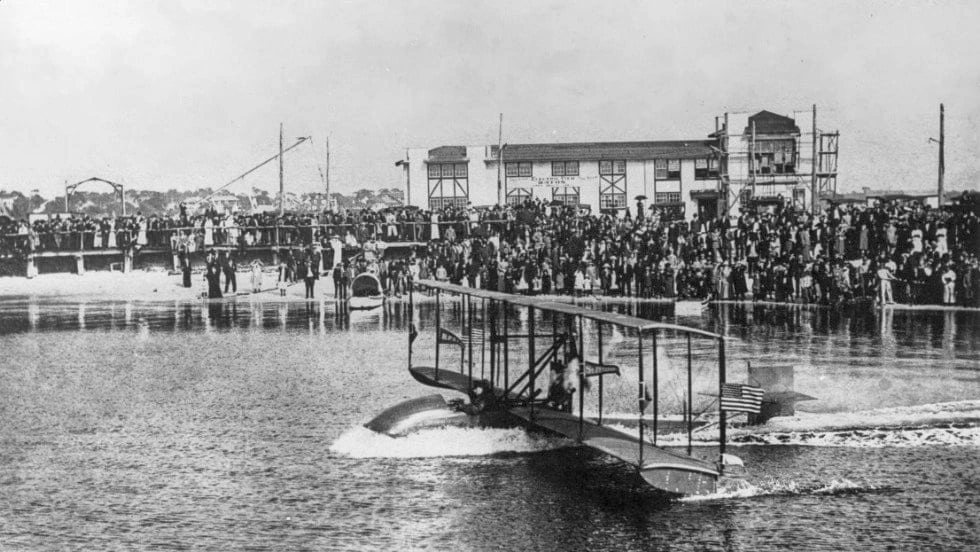
On New Year’s Day in 1914, thousands of people gathered along St. Petersburg’s waterfront to watch an experiment that seemed almost impossible.
A small flying boat sat on the water near the city’s pier. Its pilot, Tony Jannus, prepared for takeoff while former St. Petersburg mayor Abram C. Pheil climbed into the passenger seat beside him.
There was room for just one passenger.
A short time later, the aircraft lifted off over Tampa Bay and headed toward Tampa.
The flight lasted about 23 minutes. It covered roughly 20 miles. And it made transportation history.
That trip is widely recognized as the world’s first regularly scheduled commercial airline flight.
Today, Tampa Bay is known for beaches, sports, cruise ships, airports, and a growing collection of communities connected by busy bridges and highways. But more than a century ago, this stretch of water was the setting for one of the most important moments in the history of passenger travel.
Crossing Tampa Bay Was Not Easy
It is difficult to imagine now, but traveling between St. Petersburg and Tampa was once a long and inconvenient journey.
The cities were close on a map, yet Tampa Bay stood between them. A trip by rail could take much of the day, while boat travel depended on routes, schedules, and weather. For visitors and local businesspeople, getting across the bay was far from simple.
That problem caught the attention of Percival Fansler, a St. Petersburg businessman who believed aviation could offer a faster alternative.
The idea was bold. The Wright brothers had completed their first successful powered flight only a decade earlier. Airplanes were still viewed by many people as dangerous machines built for demonstrations, daredevils, or military experiments—not ordinary travelers.
Fansler saw something different.
He believed a reliable flight schedule could connect two growing Florida cities and give people a practical reason to fly.
The First Ticket Was Auctioned
Before the inaugural flight, the first seat was auctioned to the crowd.
Former mayor A. C. Pheil won the right to become the first passenger with a bid of $400. At the time, that was an extraordinary amount of money. The flight was partly a historic occasion, partly a public spectacle, and partly a serious effort to prove that commercial air travel had a future.
Pheil boarded a Benoist Model XIV flying boat, a small open-cockpit aircraft made by aviation pioneer Thomas Benoist.
The pilot, Tony Jannus, was already known as a skilled and adventurous aviator. He had experience flying over water and had helped demonstrate what early aircraft could do. But this flight was different. It was not a race, a stunt, or a private excursion.
It was the first trip on a published passenger schedule.
Jannus took off from St. Petersburg shortly before 10 a.m. and landed in Tampa about 23 minutes later. What had once required a long, indirect journey was suddenly possible in less than half an hour.
For the people watching from the waterfront, it must have felt like a glimpse into the future.
A Three-Month Airline That Changed the World
The St. Petersburg–Tampa Airboat Line did not last long.
The service operated for about three months, ending in late March 1914. It faced many of the same problems that transportation businesses still face today: operating costs, changing weather, the need for consistent demand, and the challenge of making a new service financially sustainable.
Still, the airline accomplished something remarkable during its short run.
It carried more than 1,200 passengers across Tampa Bay and demonstrated that regularly scheduled passenger flights could work. People were willing to buy a ticket, follow a schedule, and trust a flight to get them where they needed to go.
The airplanes were primitive by modern standards. Passengers sat in open cockpits beside the pilot. There were no terminals, jet bridges, security lines, boarding groups, or baggage carousels.
But the basic idea was already there: a traveler could reserve a seat, depart from one city, and arrive in another faster than by traditional transportation.
That idea would eventually change the world.
The Same Question, More Than 100 Years Later
The story of the first airline flight is also a Tampa Bay story.
For generations, people in this region have looked for better ways to move between communities separated by water, distance, traffic, and time. In 1914, a flying boat offered a daring answer.
Today, travelers have many more choices. They drive across bridges, fly through Tampa International Airport, take cruises from Port Tampa Bay, and travel between Tampa, St. Petersburg, Clearwater, Sarasota, and Florida’s Gulf Coast every day.
The technology has changed. The underlying need has not.
People still want their travel to be dependable, direct, and simple.
For passengers arriving at Tampa International Airport, getting to St. Petersburg is now a normal part of a Florida trip rather than an aviation experiment. Private transportation from TPA to St. Petersburg helps make that connection straightforward.
Where to See the History Today
Visitors can still explore this part of Tampa Bay history in St. Petersburg.
The St. Petersburg Museum of History has a Flight One Gallery dedicated to the 1914 route and the people who made it possible. The exhibit includes a full-scale Benoist flying-boat replica and tells the story of how a small local experiment helped establish commercial aviation.
A Florida historical marker near Albert Whitted Airport also commemorates the first regularly scheduled commercial airline service.
It is an easy story to miss if you are rushing to a flight, heading to the beach, or crossing the bay on one of the region’s bridges. Yet it is one of the most remarkable stories in Florida transportation history.
More than 100 years before flight-status alerts and airport lounges, a pilot and one passenger lifted off from the St. Petersburg waterfront and proved that scheduled passenger air travel could be more than an idea.
They helped show the world what travel would become.
